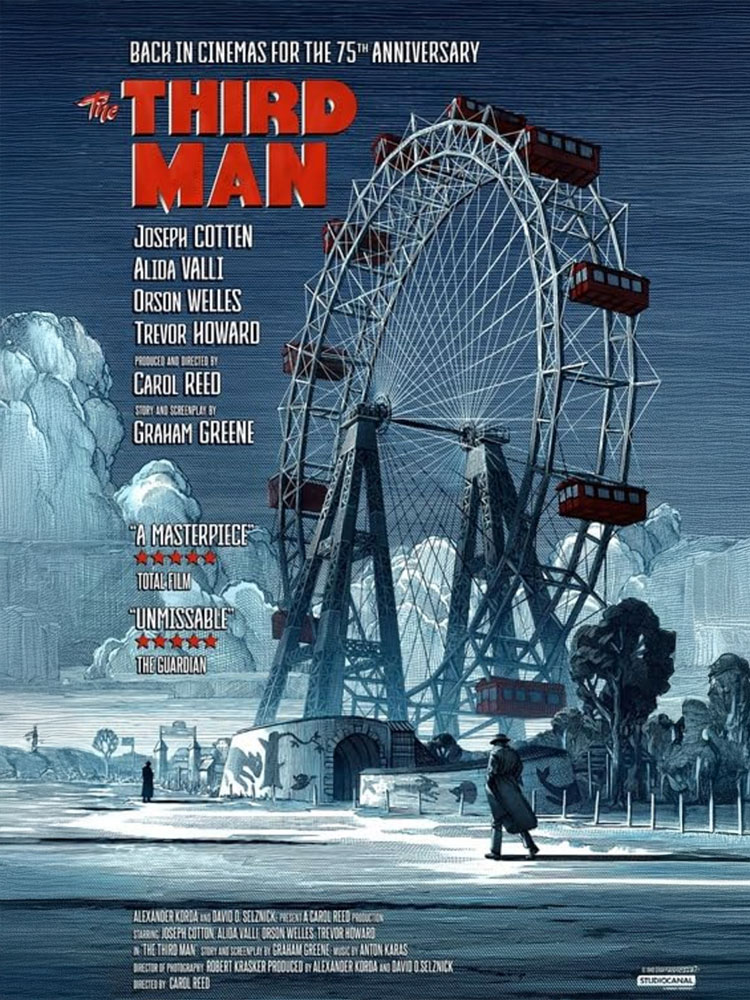


27 Jan The Third Man
Released 1949 (UK)
SUNDAY 17 April 2026 – 10.00 am
TUESDAY 19 April 2026 – 8.15 pm
RUNNING TIME 104 minutes
Synopsis:
American author Holly Martins comes to shattered post-war Vienna at the invitation of his college chum, Harry Lime.
Review: Roger Ebert
Has there ever been a film where the music more perfectly suited the action than in Carol Reed‘s The Third Man? The score was performed on a zither by Anton Karas, who was playing in a Vienna beerhouse one night when Reed heard him. The sound is jaunty but without joy, like whistling in the dark. It sets the tone; the action begins like an undergraduate lark and then reveals vicious undertones.
The story begins with a spoken prologue (‘I never knew the old Vienna, before the war. . .’). The shattered postwar city has been divided into French, American, British and Russian zones, each with its own cadre of suspicious officials. Into this sinkhole of intrigue falls an American innocent: Holly Martins (Joseph Cotton), alcoholic author of pulp Westerns. He has come at the invitation of his college chum Harry Lime. But Lime is being buried when Martins arrives in Vienna.
How did Lime die? That question is the engine that drives the plot, as Martins plunges into the murk that Lime left behind. Calloway (Trevor Howard), the British officer in charge, bluntly says Lime was an evil man, and advises Holly to take the next train home. But Harry had a girl named Anna (Alida Valli), who Holly sees at Lime’s grave, and perhaps she has some answers. Certainly, Holly has fallen in love with her, although his trusting Yankee heart is no match for her defences.
The Third Man (1949) was made by men who knew the devastation of Europe at first hand. Carol Reed worked for the British Army’s wartime documentary unit, and the screenplay was by Graham Greene, who not only wrote about spies but occasionally acted as one. Reed fought with David O. Selznick, his American producer, over every detail of the movie; Selznick wanted to shoot on sets, use an upbeat score and cast Noel Coward as Harry Lime. His film would have been forgotten in a week. Reed defied convention by shooting entirely on location in Vienna, where mountains of rubble stood next to gaping bomb craters, and the ruins of empire supported a desperate black-market economy. And he insisted on Karas’ zither music (The Third Man Theme was one of 1950’s biggest hits).
Then there are the faces: Joseph Cotton’s open, naive face contrasts with the ‘friends’ of Harry Lime: the corrupt ‘Baron’ Kurtz (Ernst Deutsch); the shifty Dr. Winkel (Erich Ponto), the ratlike Popescu (Siegfried Breuer). Even a little boy with a rubber ball looks like a wizened imp. The only trusting faces are those of innocents like the hall porter (Paul Hoerbiger) who tells Holly, ‘There was another man . . . a third man…’ and the beefy Sgt. Paine (Bernard Lee), Calloway’s aide, who levels the drunken Holly with a shot to the chin and then apologizes.
As for Harry Lime: He allows Orson Welles to make the most famous entrance in the history of the movies, and one of the most famous speeches. By the time Lime finally appears we have almost forgotten Welles is even *in* the movie. The sequence is unforgettable: the meow of the cat in the doorway, the big shoes, the defiant challenge by Holly, the light in the window, and then the shot, pushing in, on Lime’s face, enigmatic and teasing, as if two college chums had been caught playing a naughty prank.
The chase sequence in The Third Man is another joining of the right action with the right location. Harry escapes into the sewer system like a cornered rat, and Reed edits the pursuit into long, echoing, empty sewer vistas, and closeups of Lime’s sweaty face, his eyes darting for a way out. Presumably there would be no lights in the Vienna sewers, but there are strong light sources just out of sight behind every corner, throwing elongated shadows, backlighting Harry and his pursuers.
The final scene in The Third Man is a long, elegiac sigh. The movie ends as it begins, in a cemetery.
Source: www.rogerebert.com ~ Roger Ebert 8/12 /1996 Edited extracts.
Accessed 14/1/26.